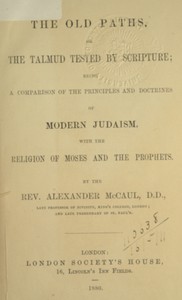
Alexander McCaul’s The Old Paths opens with a direct challenge: the Talmud, as the foundation of modern Judaism, must be tested against the Hebrew Scriptures. The author, a Christian theologian and Hebraist, positions himself as a textual critic rather than a polemicist, though his confessional stance is clear. The second-edition advertisement notes that the work has been translated into Hebrew, German, and French, and claims influence on reform movements within Judaism—a claim that frames the book as an intervention in contemporary religious debate.
The excerpts provided focus on a single, tightly argued passage about rabbinic authority and excommunication. McCaul dissects Talmudic rules that grant rabbis and their disciples the power to excommunicate those who insult them, contrasting this with the lack of recourse for the poor or unlearned. His method is forensic: he quotes the Hebrew text, translates it, and then exposes what he sees as its logical and ethical inconsistencies.
A Forensic Approach to Rabbinic Law
McCaul’s argumentative strategy is evident in his treatment of a single Talmudic law. He cites a passage from the tractate Moed Katan (or a related source) that distinguishes between a rabbi’s excommunication for his own honour and a disciple’s. The rule states that when a rabbi excommunicates for his honour, all his disciples must treat the person as excommunicate; but when a disciple does so, the rabbi is not bound, though the people are. McCaul seizes on this asymmetry: “If the rabbi be not bound to regard the disciples’ excommunication, why should all the people be bound?” He argues that this reveals the punishment as arbitrary and unjust, since the offence cannot be a sin in God’s sight if the rabbi is exempt. The logic is crisp: McCaul does not merely assert that the Talmud is wrong; he demonstrates an internal contradiction by the Talmud’s own standards.
The Social Hierarchy Embedded in the Text
McCaul’s critique extends beyond legal reasoning to the social implications of the oral law. He notes that the Talmud makes no provision for the poor or unlearned when they are insulted by a learned man: “He cannot thunder out an excommunication or an anathema in return.” The system, he argues, places the working classes at the mercy of the learned, granting every “disciple of a wise man” autocratic power. To illustrate the potential tyranny, he draws a hypothetical parallel: if the clergy or university professors in England claimed the right to excommunicate anyone who treated them with disrespect, without trial, and to dishonour their dead bodies, would that not be “monstrous and insupportable tyranny”? This analogy is designed to make the Talmudic rule vivid to a Victorian Christian audience, but it also reveals McCaul’s rhetorical method—using concrete, emotional examples to underscore abstract legal criticism.
The Author’s Stated Aim and Its Limits
McCaul is careful to distinguish his attack on Rabbinism from an attack on the Jewish people. In the advertisement, he writes that “the reproach attaches not to the victims, but to the authors of tradition,” and he praises Jews as “a great and a noble people.” He claims that many Jews are ignorant of the details of the system that has “bowed down and misrepresented them for centuries.” This framing is strategic: it allows him to criticize the Talmud while maintaining a posture of benevolence toward his Jewish contemporaries. However, the excerpts do not show McCaul engaging with Jewish responses or with the diversity of rabbinic interpretation. His argument is presented as self-evident, and he does not entertain the possibility that the Talmudic rules might be understood differently within their own legal tradition. The reader should note that the excerpts are limited to a single argumentative thread; the full work likely covers many more doctrines.
The Rhetoric of Exposure and Reform
McCaul’s central claim is that the Talmud needs only to be “seen as it is, in order to be rejected.” This phrase encapsulates his rhetorical strategy: he presents himself as a revealer of hidden truths, pulling back the curtain on a system that, he believes, cannot withstand scrutiny. The excerpts support this by showing him translating and dissecting a specific law, then drawing out its implications. He also references contemporary reform movements—the West London Synagogue, the rabbinical conferences at Brunswick and Frankfort—as evidence that his arguments are having an effect. This situates The Old Paths within a broader 19th-century debate about the authority of tradition versus scripture. For a first-time reader, the excerpts suggest that the book is not a neutral comparison but a polemic with a clear thesis: that the oral law is a human invention that has corrupted the religion of Moses.
These excerpts offer a concentrated sample of McCaul’s method: close reading of Talmudic texts, logical critique, and appeal to a Christian readership. The full work, at over 200,000 words, likely extends this approach across many doctrines. Readers should be aware that the author writes from a confessional Christian perspective and that his comparisons are designed to support a predetermined conclusion. The value of the book lies less in its fairness to rabbinic Judaism than in its detailed engagement with specific Talmudic passages, which can be examined independently.
That rainy afternoon, McCaul’s relentless comparing made me weary of arguments and gates. I closed the Talmud against the smell of wet dust, and picked up something gentler — the Psalms, as if breathing out. The old paths felt like walls, but here was a window. The Expositor's Bible: The Psalms, Vol. 1 Psalms I.-XXXVIII. — Text and Context simply opened, and the rain outside seemed less like a trial.