About 796 minutes
Woman, Church & State The Original Exposé of Male Collaboration Against the Female Sex — A Closer Reading
Theology
182,892 recorded words. 20 minutes difference from this book's estimate.
View Gutenberg source #45580
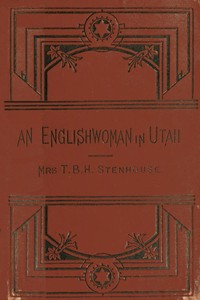
The catalog record for An Englishwoman in Utah: The Story of a Life's Experience in Mormonism — A Reader’s Guide provides practical reading context through 178,395 words, 12 hr 56 min estimated reading time, and 17 detected text sections.
The text analysis averages about 26.1 words per sentence, while the detected sections provide another way to judge how the source is divided.
Project Gutenberg metadata also associates the work with “Latter Day Saints,” connecting these edition facts with the source record’s subject description.
Explore this collection
These alternatives are selected using recorded categories and estimated reading time.
About 796 minutes
Theology
182,892 recorded words. 20 minutes difference from this book's estimate.
View Gutenberg source #45580About 797 minutes
Theology
183,138 recorded words. 21 minutes difference from this book's estimate.
View Gutenberg source #26361About 714 minutes
Theology
163,993 recorded words. 62 minutes difference from this book's estimate.
View Gutenberg source #49045Search stored excerpts and compare books → Choose by your preferences →
Choices use stored catalog measurements. Estimates vary with reading speed. A shared category is a catalog label, not a claim that two books have the same argument or literary quality.
Search reads excerpt text stored with this catalog and links to its associated Gutenberg record. The connection is stored in the site database; this tool does not recheck that every excerpt is word-for-word identical to that external record. Excerpt search does not cover every chapter and does not verify historical publication dates.
Catalog snapshot checked: 2026-09-26. Coverage: 100 public books, 100 available source excerpts.
Calculated from edition completeness, EPUB availability, text structure and catalogue metadata. Not a user rating.
Total of 100 points, scaled to a 2.5-5.0 range. Editions with an empty description or a missing EPUB file are not scored.
Public-domain source text
The source text is kept in the dedicated reader, separate from this catalogue record and its commentary.
Fanny Stenhouse's narrative moves between two poles: the intimate domestic sphere and the public arena of Mormon theocracy. In one scene, she recounts a wife earnestly selecting a second wife for her husband, only to discover the couple already know each other—a moment that exposes the calculated emotional management polygamy requires. Elsewhere, the book shifts to the Mountain Meadows Massacre, where Stenhouse documents the complicity of church leaders in the 1857 slaughter of emigrants. This structural oscillation between parlor negotiations and frontier violence gives the memoir its distinctive tension.
Stenhouse reproduces a conversation in which a Mormon sister describes proposing a plural wife to her husband. The woman insists she acted from principle, not jealousy: 'The Saints marry from principle and not from love,' she explains. When the husband turns out to be already acquainted with the girl, the wife’s composure cracks. She admits she would not have allowed the marriage if they loved each other. The passage reveals how polygamy demanded that wives suppress romantic attachment while performing enthusiasm for the system. Stenhouse lets the dialogue speak for itself, never editorializing, but the absurdity is palpable.
Throughout the excerpts, domestic decisions are never purely private. The wife who arranges a second marriage does so partly to secure a more comfortable home for the girl—a reminder that economic dependency undergirded plural marriage. Stenhouse herself, as a convert who followed her missionary husband to Utah, experienced the church’s reach into every aspect of family life. The memoir’s structure mirrors this: scenes of housework and child-rearing are interleaved with accounts of church councils and bishop’s courts. The boundary between home and institution dissolves.
Stenhouse does not organize her story chronologically by date but by thematic clusters. She jumps from a polygamy negotiation to a description of the Mountain Meadows Massacre, then back to a domestic quarrel. This restless movement mimics the unsettled life of a woman caught between loyalty to her husband and growing disillusionment. The excerpts show her using direct speech to dramatize conflicts—a technique that gives the reader the sensation of overhearing real arguments. The shifts in setting, from Salt Lake City parlors to the Utah desert, reinforce the book’s central contrast between civilized pretension and raw coercion.
Stowe’s preface frames the memoir as an abolitionist text, comparing Mormon polygamy to Southern slavery. She calls it 'a cruel slavery whose chains have cut into the very hearts of thousands of our sisters.' This comparison was politically charged in 1880, when the book appeared. Stowe’s endorsement gave Stenhouse’s story national credibility, but it also shaped how readers were meant to interpret the narrative—as an expose rather than a personal confession. The preface thus functions as a second lens, directing attention to the systemic oppression behind individual anecdotes.
Readers should attend to the way Stenhouse layers voices: her own, those of other women, and the official pronouncements of church leaders. The book is less a linear autobiography than a collage of testimonies. Because the excerpts are incomplete, the full arc of Stenhouse’s departure from Mormonism remains unclear, but the pattern of her critique is already visible in these pages. The memoir rewards those who read for its structural ingenuity as much as its historical content.
I finished An Englishwoman in Utah feeling that strange ache of someone who leaves a world they once loved. That journey from certainty to quiet doubt reminded me of another old book, one that searches for light differently, without ever losing its gentle hope. The Gospel Day; Or, the Light of Christianity — Text and Context sits beside it on my shelf now, two voices asking how we ever know what to believe.
Create a short personal record of your experience with this book.