About 324 minutes
The Way of Martha and the Way of Mary — A Reader’s Guide
Theology
74,447 recorded words. 6 minutes difference from this book's estimate.
View Gutenberg source #65157
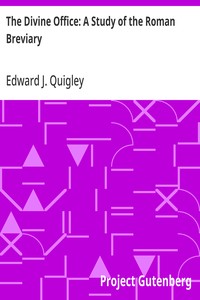
This digital edition of The Divine Office: A Study of the Roman Breviary — Key Ideas to Explore is described by source-level measurements including 75,768 words, 5 hr 30 min estimated reading time, and 7 detected text sections.
The text analysis averages about 19.3 words per sentence, while the detected sections provide another way to judge how the source is divided.
Project Gutenberg metadata also associates the work with “Catholic Church. Breviary,” connecting these edition facts with the source record’s subject description.
Explore this collection
These alternatives are selected using recorded categories and estimated reading time.
About 324 minutes
Theology
74,447 recorded words. 6 minutes difference from this book's estimate.
View Gutenberg source #65157About 351 minutes
Theology
80,677 recorded words. 21 minutes difference from this book's estimate.
View Gutenberg source #32968About 359 minutes
Theology
82,395 recorded words. 29 minutes difference from this book's estimate.
View Gutenberg source #60631Search stored excerpts and compare books → Choose by your preferences →
Choices use stored catalog measurements. Estimates vary with reading speed. A shared category is a catalog label, not a claim that two books have the same argument or literary quality.
Search reads excerpt text stored with this catalog and links to its associated Gutenberg record. The connection is stored in the site database; this tool does not recheck that every excerpt is word-for-word identical to that external record. Excerpt search does not cover every chapter and does not verify historical publication dates.
Catalog snapshot checked: 2026-09-26. Coverage: 100 public books, 100 available source excerpts.
Calculated from edition completeness, EPUB availability, text structure and catalogue metadata. Not a user rating.
Total of 100 points, scaled to a 2.5-5.0 range. Editions with an empty description or a missing EPUB file are not scored.
Public-domain source text
The source text is kept in the dedicated reader, separate from this catalogue record and its commentary.
Edward J. Quigley opens his 1920 study by acknowledging that liturgy often receives scant attention in seminary curricula, yet becomes a daily concern for priests after ordination. He positions the book as an introductory manual, aiming to give junior students knowledge of the Church's Hours and to foster devout recitation habits. The preface candidly admits the work's limitations, quoting Cardinal Bona's plea for readers to correct errors and supply omissions. This humility sets the tone for a practical, evidence-based guide rather than a comprehensive treatise.
Quigley devotes careful analysis to the Breviary's introductory formulas, treating each as a condensed lesson in theology and devotion. He explains that Domine labia mea aperies recalls God purifying Isaiah's lips and opening Zachary's mouth to bless God. Deus in adjutorium, drawn from Psalm 69, is described as the monks' continual prayer—Cassian's formula of piety—and a cry for help against distraction. The Gloria Patri is presented as the Office's purpose: the glory of the Trinity. Quigley notes its anti-Arian origin and St. Francis of Assisi's esteem for it. The Invitatory (Venite Adoremus) is framed as the Church's call to adore God, the Great Shepherd, and to pray for all, including infidels and sinners. This section demonstrates how Quigley unpacks each phrase, grounding it in Scripture, patristic sources, and liturgical history.
In a striking passage, Quigley invites readers to imagine the heavenly Jerusalem as described in Revelation: the City of God with twelve gates of pearl, streets of pure gold, and countless angels and saints around the throne. He evokes the white-robed army of martyrs, holy confessors, and virgins—the spouses of Christ—who have washed their robes in the Lamb's blood and now rest in wealthy peace. This vivid tableau serves as a model for the earthly recitation of the Office, aligning the priest's prayer with the eternal praise of heaven. Quigley's use of sensory detail—the noise of many waters, harps of God, fountains of life—transforms liturgical instruction into a contemplative meditation, urging the reader to listen to the saints' song and join their chorus.
Quigley systematically examines the Breviary's components, from the calendar and ecclesiastical year to the specific parts of each Hour. He draws on authorities such as Cardinal Bona's Rerum Liturgicarum, Cassian, St. John Climacus, and Dom Cambrol's Dictionnaire d'Archéologie Chrétienne. The book's structure reflects its pedagogical aim: Part I covers general questions (idea, history, excellence, contents), while subsequent parts likely address the Psalms, lessons, hymns, and collects. Quigley emphasizes the practical utility of knowing the Office's history and structure for attentive recitation. He notes that the Gloria Patri was especially loved by St. Francis of Assisi, who said it contained all wisdom, and traces its origin to St. Ephrem (circa 363), suggesting a Syrian origin translated into Greek and Latin.
Quigley includes 'texts and intentions' as aids for seminarians and priests to pray each Hour with attention and devotion. He stresses the importance of reciting the Office digne, attente et devote (worthily, attentively, and devoutly). The book attempts to consolidate material from multiple volumes of history, liturgy, theology, and ascetic literature into a single handy volume. Quigley hopes that new ideas on points such as the structure of the Hours, the Collects, the Te Deum, and the Anthems of the Blessed Virgin will enable more fervent prayer. He acknowledges that no book is faultless, quoting Psalm 72: 'I studied that I might know this thing, it is a labour in my sight.' This section underscores the manual's practical orientation, aimed at forming devout habits rather than mere intellectual knowledge.
Quigley's study is best approached as a companion for those already familiar with the Breviary's basic framework. Readers will benefit from having a copy of the Roman Breviary at hand to follow the textual references. The author's reliance on patristic and medieval sources rewards those who appreciate liturgical history, while the devotional passages offer material for meditation. The book's structure—moving from general principles to specific prayers—mirrors the gradual formation of a praying heart.
Flicking through Quigley’s manual on the Breviary, I found myself lingering on how its repeated psalms become a quiet rhythm, almost like a heartbeat. It put me in mind of a different kind of cadence, the careful, reasoned pulse of Paul’s letters. There’s a same gentle relentlessness there, a daily turning over of thoughts. This companion volume felt like a familiar evening: The Expositor's Bible: The Epistle of St Paul to the Romans — Reading Notes, a steady voice for unhurried reflection.
Create a short personal record of your experience with this book.