Woman, Church & State The Original Exposé of Male Collaboration Against the Female Sex — A Closer Reading
Edition facts
This digital edition of Woman, Church & State The Original Exposé of Male Collaboration Against the Female Sex — A Closer Reading is described by source-level measurements including 182,892 words, 13 hr 16 min estimated reading time, and 26 detected text sections.
The text analysis averages about 25.8 words per sentence, while the detected sections provide another way to judge how the source is divided.
Project Gutenberg metadata also associates the work with “Women's rights -- United States,” connecting these edition facts with the source record’s subject description.
Calculated from edition completeness, EPUB availability, text structure and catalogue metadata. Not a user rating.
How this score is calculated
- Description quality20 pts
- Title & short description10 pts
- Source metadata20 pts
- Text length15 pts
- Chapters / structure15 pts
- EPUB file integrity20 pts
Total of 100 points, scaled to a 2.5-5.0 range. Editions with an empty description or a missing EPUB file are not scored.
Read the Text
vernment. He also says the people who possessed the Mother-rule together with Gynaikokraty (girls’ rule) excelled in their love of peace and justice. Under the Matriarchal family and tribal system even long after its partial supersedence by the incoming Patriarchate, the marriage relation was less oppressive to woman than it has been under most centuries of christian civilization. Daughters were free in their choice of husbands, no form of a force or sale existing.[17]
One of the most brilliant modern examples of the Matriarchate was found in Malabar at the time of its discovery by the Portuguese in the XV century. The Nairs were found to possess a fine civilization, entirely under the control of women, at a period when woman’s position in England and on the Continent of Europe, was that of a household and political slave. Of Malabar it has been said, that when the Portuguese became acquainted with the country and the people, they were not so much surprised by the opulence of their cities, the splendor of all their habits of living, the great perfection of their navy, the high state of the arts, as they were to find all this under the entire control and government of women. The difference in civilization between christian Europe and pagan Malabar at the time of its discovery was indeed great. While Europe with its new art of printing, was struggling against the church for permission to use type, its institutions of learning few, its opportunities for education meagre; its terrible inquisition crushing free thought and sending thousands each year to a most painful death, the uncleanliness of its cities and the country such as to bring frequent visits of the plague; its armies and its navies with but one exception, imperfect; its women forbidden the right of inheritance, religious, political, or household authority;—the feminine principle entirely eliminated from the divinity—a purely masculine God the universal object of worship, all was directly the opposite in Malabar. Cleanliness, peace, the arts, a just form of government, the recognition of the feminine both in humanity and in the divinity were found in Malabar. To the question of a Danish missionary concerning their opinion of a Supreme Being, this beautiful answer was given.
The Supreme Being has a Form and yet has no Form; he can be likened to nothing; we cannot define him and say that he is this or that; he is neither Man or Woman; neither Heaven or Earth, and yet he is all; subject to no corruption, no mortality and with neither sleep nor rest, he is Almighty and Omnipotent without Beginning and without End.[18]
Under the Missionaries sent by England to introduce her own barbaric ideas of God and man, this beautiful Matriarchal civilization of Malabar soon retrograded and was lost.
The ancient Mound Builders of America, of whom history is silent and science profoundly ignorant, are proven by means of symbolism to have been under Matriarchal rule, and Motherhood religion. Anciently motherhood was represented by a sphere or circle. The circle, like the mundane egg, which is but an elongated circle, contains everything in itself and is the true microcosm. It is eternity, it is feminine, the creative force, representing spirit. Through its union with matter in the form of the nine digits it is likewise capable of representing all natural things.[19] The perfect circle of Giotto was an emblem of divine motherhood in its completeness. It is a remarkable fact—its significance not recognized,—that the roughly sketched diameter within the circle, found wherever boys congregate, is an ancient mystic sign[20] signifying the male and female, or the double-sexed deity. It is the union of all numbers, the one within the zero mark comprising ten, and as part of the ancient mysteries signifying God, the creative power, and eternal life; it was an emblem of The All.
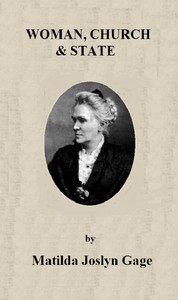
Matilda Joslyn Gage opens Woman, Church & State with a bold claim: the earliest human societies were matriarchal, and women enjoyed freedoms later stripped away by religious and legal institutions. The table of contents alone signals her method—chapter titles such as “The Matriarchate,” “Celibacy,” and “Canon Law” map a systematic argument rather than a chronological narrative. Gage draws on the Iroquois Confederacy as a living example of mother-rule, noting that the United States government borrowed from its structure. This framing immediately positions the reader to see patriarchy not as natural but as a historical construct enforced by church and state.
The Matriarchate as a Lost Baseline
Gage devotes her first chapter to establishing the matriarchate as a widespread historical reality. She cites traces among “many nations,” from ancient Egypt to Malabar, and emphasizes that monogamy, not polygamy, was the rule under mother-rule. The Iroquois receive particular attention: Gage describes a government where women held authority, and she credits this system with the first conception of “inherent rights.” This evidence is not merely antiquarian—it serves as a benchmark against which later Christian and patriarchal institutions are measured. The reader should note that Gage treats the matriarchate as a global phenomenon, not a local anomaly.
Celibacy and the Double Moral Standard
Chapter Two, “Celibacy,” argues that the church’s elevation of virginity degraded marriage and women. Gage claims that “woman not regarded as a human being by the church” and that clerical celibacy led to “a double Code of Morals.” She lists consequences: wives sold as slaves, women driven to suicide, and monastic life used to drain women of wealth. The chapter extends to Protestant orders and even Mexico under President Diaz, suggesting that the pattern crosses denominations and continents. Gage’s tone is accusatory, and she relies on a cascade of specific harms rather than abstract theology.
Canon Law as a Tool of Dispossession
In “Canon Law,” Gage examines how ecclesiastical courts reshaped property and family rights. She notes that husbands could leave wives no more than one-third of their property, and daughters could be disinherited while sons could not. The clergy formed “a distinct body from the laity” with separate legal standards—seven witnesses were needed to convict a priest. Gage highlights the Reformation’s failure to change these laws, and she points to contemporary governments, including the U.S., catering to Pope Leo XIII. The legal detail is dense, but the pattern is clear: law served male clerical power.
Property Rights and the Irish Example
Later excerpts focus on Ireland and Wales as case studies in the erosion of women’s property rights. Gage contrasts ancient Irish law, which gave wives control over their own property, with English-imposed Christian law that transferred that control to husbands. She cites the Senchus Mor tradition and notes that the wife without possessions “became the slave of her husband.” Welsh law similarly allowed wives separate property and even grounds for divorce based on a husband’s “fetid breath.” Gage uses these examples to argue that Christianization, not civilization, dismantled women’s legal standing.
Gage’s argument is cumulative: each chapter adds another layer of institutional collaboration against women. Readers will benefit from tracking her use of legal codes and historical anecdotes, as these form the backbone of her evidence. The book does not offer a narrative of progress but a warning about the durability of patriarchal structures. Approaching the text as a legal and historical brief rather than a polemic will reveal the depth of Gage’s research and the precision of her indictment.
Sitting with Woman, Church & State, I kept circling back to a quieter thread—how institutional memory gets rewritten by those in power. It reminded me, oddly, of another text I once lingered over, one that traces a similar loss of early freedom within religious history. That felt less like comparison and more like finding an old echo: The Great Apostasy, Considered in the Light of Scriptural and Secular History — A Closer Reading, where the turning away is also recorded, gently, as a kind of forgetting.

There are no reviews for this eBook.
Before you leave, reflect on the book
Use these questions to collect your thoughts before moving on.