About 180 minutes
Japan Will Turn Ablaze! — Background and Themes
Theology
41,398 recorded words. 2 minutes difference from this book's estimate.
View Gutenberg source #19236
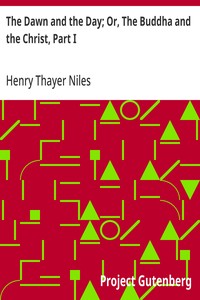
For The Dawn and the Day; Or, The Buddha and the Christ, Part I — Inside the Classic, the stored edition analysis reports 41,832 words, 3 hr 2 min estimated reading time, and 4 detected text sections.
The text analysis averages about 35.1 words per sentence, while the detected sections provide another way to judge how the source is divided.
Project Gutenberg metadata also associates the work with “Religious poetry,” connecting these edition facts with the source record’s subject description.
Explore this collection
These alternatives are selected using recorded categories and estimated reading time.
About 180 minutes
Theology
41,398 recorded words. 2 minutes difference from this book's estimate.
View Gutenberg source #19236About 178 minutes
Theology
40,890 recorded words. 4 minutes difference from this book's estimate.
View Gutenberg source #12364About 174 minutes
Theology
39,877 recorded words. 8 minutes difference from this book's estimate.
View Gutenberg source #50535Search stored excerpts and compare books → Choose by your preferences →
Choices use stored catalog measurements. Estimates vary with reading speed. A shared category is a catalog label, not a claim that two books have the same argument or literary quality.
Search reads excerpt text stored with this catalog and links to its associated Gutenberg record. The connection is stored in the site database; this tool does not recheck that every excerpt is word-for-word identical to that external record. Excerpt search does not cover every chapter and does not verify historical publication dates.
Catalog snapshot checked: 2026-09-26. Coverage: 100 public books, 100 available source excerpts.
Calculated from edition completeness, EPUB availability, text structure and catalogue metadata. Not a user rating.
Total of 100 points, scaled to a 2.5-5.0 range. Editions with an empty description or a missing EPUB file are not scored.
Public-domain source text
The source text is kept in the dedicated reader, separate from this catalogue record and its commentary.
Henry Thayer Niles's The Dawn and the Day; Or, The Buddha and the Christ, Part I (1894) opens with a preface that frames the entire work as a comparative theological exercise. Niles invokes Humboldt and Max Müller to argue that fundamental moral truths—brotherhood, love, overcoming evil with good—appear in both Buddhism and Christianity, while dogmas and legends remain “as wide asunder as the poles.” The poem itself then dramatizes this tension through narrative verse, beginning with a scene in which Buddha prevents the sacrifice of a goat, reasoning that “God, being good” cannot “delight in blood.”
Niles’s preface does not merely introduce; it establishes the poem’s intellectual stakes. He compares Humboldt’s observation of analogous flora on different continents to Max Müller’s discovery of “Dyaus Pitar” as a cognate for “Zeus Pater” and “Our Father.” This analogy serves to naturalize the presence of Christian-like truths in Buddhism without requiring direct borrowing. Niles explicitly rejects both the theory that Buddhists derived their ethics from Nestorian Christians and the counter-claim that Christianity borrowed from Buddhist missionaries. Instead, he posits a common divine source. The preface thus functions as a theological argument in miniature, preparing the reader to view the ensuing narrative not as mere story but as evidence of universal religious harmony.
In the central excerpt, Buddha’s intervention at the sacrifice is less a miracle than a sustained ethical lecture. He employs a series of similes to describe sin: it works “like corroding rust and eating moth,” “like poisoned blood,” “like deadly drug,” “like fell disease.” Each image emphasizes internal, automatic consequence rather than external punishment. The passage culminates in a garden metaphor: “patient labor, day by day, / Uprooting cherished evils one by one” is required to grow the “precious seed” of virtue. Niles’s Buddha does not invoke divine command but natural law—sin produces its own suffering, and reform requires gradual cultivation. The king and priests are persuaded not by authority but by the logic of these analogies, and the altar is replaced with flowers.
After the sacrifice scene, the poem shifts to a detailed description of the landscape as Siddhartha departs. The “five bold hills” and “two outer gates” of the mountain rampart are mapped with precision: the western gate opens “toward Gaya, through the red Barabar hills,” and the Phalgu River winds past lotus-covered plains. This geographical specificity grounds the narrative in a real topography, but Niles also uses it to mark a transition. Siddhartha becomes homeless—“Buddha had not whereon to lay his head”—and the description of his journey is juxtaposed with a meditation on how “men marked distance in those ancient times” versus the “headlong age” of the present. The landscape thus serves as both setting and symbol of the renunciation central to the Buddha’s path.
Readers should attend to how Niles balances narrative momentum with doctrinal exposition. The poem’s blank verse often shifts between concrete action (loosing the goat, walking through the gate) and extended simile or moral commentary. The preface’s argument about shared fundamentals versus divergent dogmas provides a lens for interpreting these shifts: the story illustrates the fundamentals, while the dogmatic differences may emerge in later parts not included here. This first part establishes a Buddha who teaches through analogy and example, setting the stage for a Christ whose teachings may be presented in parallel form.
I’ve often thought Niles’s Buddha, halting that poor goat with such gentle urgency, shares a quiet kinship with the psalmists’ pleading for mercy. Both knew the weight of blood and the ache for something holier. In The Dawn and the Day that cry feels ancient; in The Expositor's Bible: The Psalms, Vol. 1 Psalms I.-XXXVIII. — Text and Context it breathes again, just as raw.
A brief reflection can help important ideas stay with you longer.