About 239 minutes
The Great Apostasy, Considered in the Light of Scriptural and Secular History — A Closer Reading
Theology
54,941 recorded words. 0 minutes difference from this book's estimate.
View Gutenberg source #35514
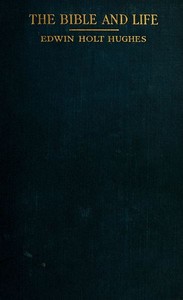
The Bible and Life — Themes and Context can be approached with a clearer sense of reading commitment from its source measurements: 54,838 words, 3 hr 59 min estimated reading time, and 5 detected text sections.
The text analysis averages about 18.4 words per sentence, while the detected sections provide another way to judge how the source is divided.
Project Gutenberg metadata also associates the work with “Bible -- Appreciation,” connecting these edition facts with the source record’s subject description.
Explore this collection
These alternatives are selected using recorded categories and estimated reading time.
About 239 minutes
Theology
54,941 recorded words. 0 minutes difference from this book's estimate.
View Gutenberg source #35514About 248 minutes
Theology
56,966 recorded words. 9 minutes difference from this book's estimate.
View Gutenberg source #57513About 201 minutes
Theology
46,186 recorded words. 38 minutes difference from this book's estimate.
View Gutenberg source #12586Search stored excerpts and compare books → Choose by your preferences →
Choices use stored catalog measurements. Estimates vary with reading speed. A shared category is a catalog label, not a claim that two books have the same argument or literary quality.
Search reads excerpt text stored with this catalog and links to its associated Gutenberg record. The connection is stored in the site database; this tool does not recheck that every excerpt is word-for-word identical to that external record. Excerpt search does not cover every chapter and does not verify historical publication dates.
Catalog snapshot checked: 2026-09-26. Coverage: 100 public books, 100 available source excerpts.
Calculated from edition completeness, EPUB availability, text structure and catalogue metadata. Not a user rating.
Total of 100 points, scaled to a 2.5-5.0 range. Editions with an empty description or a missing EPUB file are not scored.
Public-domain source text
The source text is kept in the dedicated reader, separate from this catalogue record and its commentary.
Edwin Holt Hughes opens The Bible and Life by declaring that his lectures, delivered at DePauw University, will stay “strictly within the radius of real life.” He explicitly sets aside technical biblical scholarship—theories of inspiration, dates, authorships—in favor of an argument from “actual living.” This choice shapes every page: Hughes treats the Bible not as a remote artifact but as a book whose authority is demonstrated through its engagement with ordinary human experience. The excerpts show a writer who prefers concrete examples over doctrinal exposition, building his case by moving from scriptural narrative to contemporary application.
Hughes’s prose is marked by a deliberate plainness. He avoids technical jargon and instead strings together vivid, familiar images: a woman and her leaven, a fisherman and his net, a shepherd and his sheep. In the chapter on work, he lists biblical figures called from their occupations—Moses from tending flocks, Saul from seeking cattle, David from the sheepfold, Ruth from gleaning—and notes that “the favorite meeting place of God with man is the meeting place of man with his work.” The repetition of this pattern, with its parallel structure and accumulating examples, creates a rhythmic insistence that the sacred is embedded in the mundane. Hughes does not argue abstractly; he piles up instances until the point feels self-evident.
The longest excerpt centers on labor, and Hughes’s method is on full display. He catalogs Old Testament workers—Gideon beating out wheat, Elisha plowing with twelve yoke of oxen, Nehemiah serving as cupbearer—then turns to the New Testament, where Matthew sits at the seat of custom and James and John pull their boat “over the blue waves.” The phrase “blue waves” is a rare touch of color in an otherwise functional vocabulary. Hughes’s point is that the Bible “shows a preference for the workers as against the shirks,” and he drives it home by noting that Jesus’s parables consistently draw on employment: the merchant, the sower, the woman with leaven, the fisherman. The argument is cumulative, not analytical; Hughes trusts the weight of repetition to persuade.
The book’s table of contents reveals a clear architecture: eight chapters pairing biblical themes with life domains—Home, Education, Work, Wealth, Sorrow, Practice. Each chapter likely follows the pattern visible in the work excerpt: a thesis stated plainly, a procession of scriptural examples, and a turn to Christ as the culminating illustration. Hughes writes as a preacher-lecturer, building toward application. The introduction notes that the lectures were delivered “in Meharry Hall” to “hundreds of youthful hearers,” and the prose retains an oral quality—short, declarative sentences, rhetorical questions implied rather stated, and a steady forward momentum. The book is designed to be heard as much as read.
Hughes is careful to limit his authority. He writes in the introduction that he does “not claim to be a biblical scholar in any technical sense.” This disclaimer is strategic: it frees him to focus on practical piety rather than academic debate. The lectures were founded by a bequest requiring “the exhibition of the proofs, from all sources, of the Divine Origin, Inspiration, and Authority of the Holy Scriptures,” but Hughes interprets this mandate broadly. He treats the Bible’s relevance to daily life as itself a proof. His tone is confident but not combative; he assumes a sympathetic audience of students who share his Christian commitment. The book is an apology, but one that argues by demonstration rather than confrontation.
Readers approaching The Bible and Life will find a work that is less about the Bible as a text than about the Bible as a resource for living. Hughes’s method—accumulating scriptural examples and applying them to common experience—makes the book accessible, but it also means that his arguments depend on the reader’s willingness to accept the examples as sufficient. The lectures reward attention to their rhetorical structure: the way Hughes builds a case through repetition, the careful selection of details, and the consistent turn from ancient narrative to present application. This is a book best read as a performance of practical theology.
I kept thinking about that editorial note—how Hughes found the Bible in everyday work, not just in grand theology. It reminded me of another quiet companion, Men of the Bible — Story, Setting & Ideas, which lingers the same way, letting familiar lives feel close and human again.
A brief reflection can help important ideas stay with you longer.