About 239 minutes
The Great Apostasy, Considered in the Light of Scriptural and Secular History — A Closer Reading
Theology
54,941 recorded words. 9 minutes difference from this book's estimate.
View Gutenberg source #35514
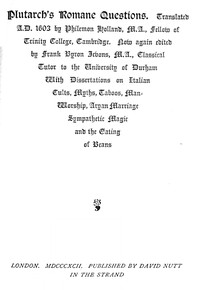
The catalog record for Plutarch's Romane Questions With dissertations on Italian cults, myths, taboos, man-worship, aryan marriage, sympathetic magic and the eating of beans — Context and Discussion provides practical reading context through 56,966 words, 4 hr 8 min estimated reading time, and 9 detected text sections.
The text analysis averages about 30.9 words per sentence, while the detected sections provide another way to judge how the source is divided.
Project Gutenberg metadata also associates the work with “Rome -- Religion -- Early works to 1800,” connecting these edition facts with the source record’s subject description.
Explore this collection
These alternatives are selected using recorded categories and estimated reading time.
About 239 minutes
Theology
54,941 recorded words. 9 minutes difference from this book's estimate.
View Gutenberg source #35514About 239 minutes
Theology
54,838 recorded words. 9 minutes difference from this book's estimate.
View Gutenberg source #41520About 289 minutes
Theology
66,261 recorded words. 41 minutes difference from this book's estimate.
View Gutenberg source #16076Search stored excerpts and compare books → Choose by your preferences →
Choices use stored catalog measurements. Estimates vary with reading speed. A shared category is a catalog label, not a claim that two books have the same argument or literary quality.
Search reads excerpt text stored with this catalog and links to its associated Gutenberg record. The connection is stored in the site database; this tool does not recheck that every excerpt is word-for-word identical to that external record. Excerpt search does not cover every chapter and does not verify historical publication dates.
Catalog snapshot checked: 2026-09-26. Coverage: 100 public books, 100 available source excerpts.
Calculated from edition completeness, EPUB availability, text structure and catalogue metadata. Not a user rating.
Total of 100 points, scaled to a 2.5-5.0 range. Editions with an empty description or a missing EPUB file are not scored.
Public-domain source text
The source text is kept in the dedicated reader, separate from this catalogue record and its commentary.
Plutarch's Romane Questions opens with a deceptively simple query: why must a new bride touch fire and water? The answers Plutarch entertains range from high philosophical reasoning—fire and water as principles of generation—to a strikingly humane suggestion: that spouses should share all fortunes, having nothing else in common but these elements. This pattern, where a mundane custom prompts a cascade of learned explanations, defines the work's method. The editor, F.B. Jevons, notes in his preface that Plutarch's answers assume the customs were deliberately instituted by men as cultured as himself, a premise Jevons challenges by pointing to the Stone Age reality of the early Aryans. The result is a text that oscillates between erudite speculation and a kind of inadvertent self-portrait of Plutarch's own generous character.
Holland's 1603 translation gives Plutarch's questions a distinctive English voice, one that is both archaic and vigorous. His phrasing—'disasterous or dismall daies,' 'carieth no congruitie at all, nor apparence of reason'—preserves the texture of early modern English while conveying Plutarch's logical scrutiny. Holland often expands the original with explanatory clauses, as when he glosses 'the morrow after the Ides' by adding 'which was the same that July now is.' This habit of bridging ancient and contemporary references makes the text feel immediate, even as its language distances the reader. The translator's presence is felt in the rhythm of the sentences, which frequently pile up alternatives introduced by 'Is it because…' or 'Or last of all…,' mimicking the structure of Plutarch's own enumerations.
In Question 25, concerning why the days after Calends, Nones, and Ides are considered unlucky, Plutarch first cites a historical explanation: the Roman defeat at the Allia. He then immediately undermines it, noting that the battle occurred on a different day and that the superstition extends beyond a single month. He proceeds to offer an alternative rooted in religious calendar theory—that the first days are sacred to celestial gods, the second to infernal spirits—and finally a numerological argument about odd and even numbers. This layered approach, where each hypothesis is presented and then qualified, is typical of the Romane Questions. Plutarch does not settle on one answer but leaves the reader to weigh the possibilities, a method that Jevons compares to modern folkloric inquiry, though he notes the crucial difference in underlying assumptions.
F.B. Jevons' preface and dissertations frame Plutarch's work as 'the earliest formal treatise on the subject of folk-lore.' He argues that while Plutarch's questions anticipate modern science, his answers are anachronistic, projecting contemporary philosophy onto primitive minds. Jevons' own dissertations—on topics like 'Aryan Marriage' and 'Sympathetic Magic'—reflect late Victorian anthropology, with its comparative method and evolutionary assumptions. The juxtaposition is instructive: Plutarch explains customs by imagining rational founders; Jevons explains them by reconstructing prehistoric thought. Readers should note that Jevons' contributions are themselves products of their era, and his confidence in reconstructing 'Stone Age' beliefs may now seem as dated as Plutarch's reliance on Greek philosophy.
This edition offers two layers of interpretation: Plutarch's own, filtered through Holland's English, and Jevons' late-Victorian commentary. The reader is encouraged to attend to the gaps between them—where Plutarch sees deliberate design, Jevons sees unconscious survival. The Romane Questions reward a slow reading that savors the play of hypotheses and the texture of early modern prose, while the dissertations provide a contrasting lens that reveals as much about the 1890s as about ancient Rome.
I sometimes set Plutarch’s old questions beside The New Testament of our Lord and Savior Jesus Christ. The common English version, corrected by the final committee of the American Bible Union. — Text and Context, and think how both ask what people truly meant by their rituals—one through temple bones, the other through troubled new words. A hushed fellowship there, across centuries, sharing a patient ear for old strangeness.
A brief reflection can help important ideas stay with you longer.