
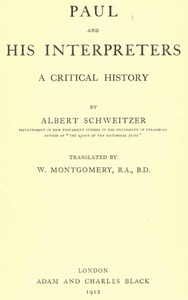
Paul and his interpreters — Inside the Classic

(0 User reviews)   816
In Category - Theology
Schweitzer, Albert, 1875-1965, Montgomery, W. (William), 1871-1930 [Translator] Project Gutenberg 2025 Not confirmed
Paul, the Apostle, Saint; Bible. Epistles of Paul -- Criticism, interpretation, etc. -- History Readers of public-domain and historical texts
Project Gutenberg digital edition en

Edition facts

Words 92,997
Reading time 405 min
Text sections 13

This digital edition of Paul and his interpreters — Inside the Classic is described by source-level measurements including 92,997 words, 6 hr 45 min estimated reading time, and 13 detected text sections.

The text analysis averages about 20.3 words per sentence, while the detected sections provide another way to judge how the source is divided.

Project Gutenberg metadata also associates the work with “Paul, the Apostle, Saint,” connecting these edition facts with the source record’s subject description.

Albert Schweitzer's critical history examines how scholars from the 19th to early 20th century interpreted Paul's theology, focusing on methodological tensions between systematic reconstruction and textual criticism, with particular attention to the problem of explaining the transition from Jesus to early Greek theology.
Share
Editorial Edition Score 4.8/5

Calculated from edition completeness, EPUB availability, text structure and catalogue metadata. Not a user rating.

How this score is calculated
  • Description quality20 pts
  • Title & short description10 pts
  • Source metadata20 pts
  • Text length15 pts
  • Chapters / structure15 pts
  • EPUB file integrity20 pts

Total of 100 points, scaled to a 2.5-5.0 range. Editions with an empty description or a missing EPUB file are not scored.

Edition quality

Read the Text

tain parts of the Epistle to the Colossians which made a strong impression of genuineness. Holtzmann offered a solution which gave general satisfaction. He adopted the hypothesis that Colossians was based upon a genuine Pauline letter which had been worked over by a later hand._(_27_)_ The redactor he identified with the author of the Epistle to the Ephesians.

While there was this general consensus in the critical camp, which was ratified in Holtzmann’s “Introduction,”_(_28_)_ the most diverse opinions on special points are found. Some attempts were made to save the [pg 027] genuineness of the second Epistle to the Thessalonians. For some, the Epistles to the Colossians and Ephesians are genuine throughout and represent a later phase of the Pauline theology. Nor were there lacking attempts of all kinds to rehabilitate the Pastoral Epistles. Those who did not venture to defend them as wholes make a point of retaining at least the “personal references.”

The presentation of the Pauline teaching was, however, hardly affected by the literary divergences. Not even the most conservative of the critics had the boldness to place all the letters which have come down under the name of Paul on a footing of equality. Even those who regarded the Epistles to the Ephesians and Colossians as genuine did not fuse ideas of these Epistles with the system extracted from the four main Epistles, but presented them separately; and any who were not converted to the rejection of the Pastorals at all events took the precaution to give a separate chapter to the Pauline theology of these writings._(_29_)_ If only the personal references might be saved, these Epistles were as completely excluded from the presentation of the Pauline system as if they had been pronounced wholly spurious.

Thus it continued to be the case, as it had been with Baur, that, generally speaking, only the four main epistles were taken into account in describing the Pauline system. The only significant change was that the epistle to the Philippians began to be put on the same footing, and, with a few exceptions, scholars no longer hesitated to regard as Pauline the conception of the pre-existence of Christ which is expressed in the section on the incarnation and obedience unto death. It was realised that the main epistles also presuppose this view, even if they do not state it so explicitly.

There were, of course, as time went on, attempts to [pg 028] explain the composition of the four main epistles and Philippians as arising by the working up together in each single epistle of two or more originals, but these were not of any real importance for the study of the Pauline doctrine. It was only a carrying out of the task suggested by Semler, when he pointed out that we have not got the letters in their original form but only as prepared for public reading by the early Church. But the constitution of the Pauline material is scarcely affected by the attempts to reconstruct these originals. They have a purely literary interest.

Theology, so far as it was occupied with the study of the Pauline system, did not allow itself to be at all disquieted by the rejection of the whole of the Epistles proposed by Bruno Bauer in his “Criticism of the Pauline Letters.”_(_30_)_ Nor was its confidence shaken by the hypothesis that the letters have been worked over to a very large extent and in a very thoroughgoing fashion. Christian Hermann Weisse’s “Contributions to the Criticism of the Pauline Epistles,”_(_31_)_ which appeared in 1867, where he sets forth the justification and the principles of this method, scarcely attracted any attention, as was indeed the case with almost all the theological work of this writer.

The elucidation of the details of the Pauline doctrine is vigorously pursued. An empirical definition is attempted of the terms sin, law, conscience, justification, redemption, election, and freedom. A special interest attaches to the study of the terms flesh and spirit. After Holsten had endeavoured to trace the significance of the word flesh, Lüdemann—in a brilliant work published in 1872—endeavoured to arrive at a clear idea of the Apostle’s anthropology and its place in his doctrine of salvation.

Schweitzer opens this work by declaring it a continuation of his earlier Quest of the Historical Jesus, insisting that any new reading of Jesus must trace the pathway to the history of dogma. He argues that the conventional academic division into Life of Jesus, Apostolic Age, and History of Dogma is a confession of incompetence, leaving the transition from Jesus to Paul and from Paul to early Greek theology unexplained. The book thus sets out to examine how critical scholars have handled Paulinism as an integral part of dogma's development, beginning immediately after Jesus' death.

The Unfinished Task: From Jesus to Greek Theology

Schweitzer identifies a persistent gap in scholarship: explaining how the teaching of Jesus developed into the early Greek theology found in Ignatius, Justin, Tertullian, and Irenaeus. He notes that Strauss and Renan attempted this, but no one since has followed. The history of dogma, he charges, begins its solid masonry only in the Greek period, leaving the earlier foundations supported on piles. Paulinism, he insists, is not a separate department but an integral part of dogma's history. The book's preface frames this as a necessity for any scholar offering a new reading of Jesus: they must trace the pathway to dogma to show what their discovery is worth.

Critique of Textual Surgery: Cutting Up the Epistles

Schweitzer is sharply critical of scholars who treat the Pauline epistles as composite documents to be dissected and rearranged. He compares them to surgeons who think more of their skill with the knife than of diagnosis, and who fall victim to unnecessary operations. He notes that the criteria for deletions and combinations are always derived from subjective impression. While acknowledging that such work may affect pre-canonical literary history, he argues it hardly alters knowledge of the Pauline system. He singles out Spitta's work on Romans as standing above average, but notes it requires accepting the burdensome hypothesis of a second imprisonment and the genuineness of the Pastoral epistles.

Holtzmann's Rebuke and the State of Scholarship

Schweitzer reports that Holtzmann reproached dissection critics with 'straining out the gnat' and indulging in critical vivisection instead of studying the currents of Jewish and Hellenistic thought running side by side through Paul's work. Yet Schweitzer notes a curious irony: Holtzmann himself, when asked why he never lectured on Romans, said its composition was too problematical for him to venture to deal with it unless obliged. This anecdote underscores the methodological impasse Schweitzer diagnoses: scholars either dissect texts without adequate diagnosis, or avoid the central problems altogether. The book's survey of positions at the beginning of the twentieth century includes Feine, Wernle, and Weinel, each addressing different aspects of Paul's gospel, missionary work, and church organization.

Schweitzer's work is best read as a companion to his Quest of the Historical Jesus, sharing its insistence on coherent historical explanation. Readers should note that the excerpts provide only the preface and a portion of the critical survey; the full book develops Schweitzer's own constructive interpretation of Paul. The editorial note here is limited to what the supplied text reveals about Schweitzer's method and his assessment of other scholars.

Schweitzer’s book stayed with me because it shows how every generation quietly reshapes Paul to fit its own questions. It made me think of an older, stranger dialogue I stumbled across once, The old paths, or the Talmud tested by Scripture Being a comparison of the principles and doctrines of modern Judaism with the religion of Moses and the prophets — Key Ideas to Explore, where the same tension hums beneath every page—how do we hear an ancient voice without drowning it in our own?

There are no reviews for this eBook.

0
0 out of 5 (0 User reviews )

Add a Review

Your Rating *
There are no comments for this eBook.

Reader reflection

Record your reading impressions

A brief reflection can help important ideas stay with you longer.

Your progress 0 / 10
1

Which reading stage best describes you?

2

Did this book hold your interest?

3

Would you encourage someone else to read it?

4

How easy was the book to follow?

Related eBooks