About 689 minutes
History of Dogma, Volume 1 — Edition Insights
Comparative Religion
158,328 recorded words. 128 minutes difference from this book's estimate.
View Gutenberg source #19612
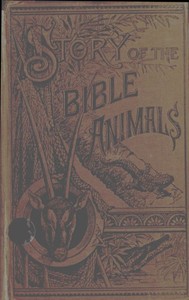
The source record for Story of the Bible Animals A Description of the Habits and Uses of every living Creature mentioned in the Scriptures, with Explanation of Passages in the Old and New — A Closer Reading measures this digital text at 187,699 words, 13 hr 37 min estimated reading time, and 27 detected text sections.
The text analysis averages about 27.3 words per sentence, while the detected sections provide another way to judge how the source is divided.
Project Gutenberg metadata also associates the work with “Animals in the Bible,” connecting these edition facts with the source record’s subject description.
Explore this collection
These alternatives are selected using recorded categories and estimated reading time.
About 689 minutes
Comparative Religion
158,328 recorded words. 128 minutes difference from this book's estimate.
View Gutenberg source #19612About 680 minutes
Comparative Religion
156,382 recorded words. 137 minutes difference from this book's estimate.
View Gutenberg source #73092About 1,186 minutes
Comparative Religion
272,688 recorded words. 369 minutes difference from this book's estimate.
View Gutenberg source #17Search stored excerpts and compare books → Choose by your preferences →
Choices use stored catalog measurements. Estimates vary with reading speed. A shared category is a catalog label, not a claim that two books have the same argument or literary quality.
Search reads excerpt text stored with this catalog and links to its associated Gutenberg record. The connection is stored in the site database; this tool does not recheck that every excerpt is word-for-word identical to that external record. Excerpt search does not cover every chapter and does not verify historical publication dates.
Catalog snapshot checked: 2026-09-26. Coverage: 100 public books, 100 available source excerpts.
Calculated from edition completeness, EPUB availability, text structure and catalogue metadata. Not a user rating.
Total of 100 points, scaled to a 2.5-5.0 range. Editions with an empty description or a missing EPUB file are not scored.
Public-domain source text
The source text is kept in the dedicated reader, separate from this catalogue record and its commentary.
J. G. Wood opens his preface with a direct claim: the Bible cannot be rightly understood without studying the customs, manners, and natural history of the Eastern peoples who produced it. He argues that scriptural writings abound with metaphors drawn from common life—trees, birds, beasts, and creeping things—and that without understanding these references, readers will misinterpret not only the Old and New Testaments but the words of Christ himself. Wood’s project is therefore both zoological and hermeneutic: to take every creature named in Scripture and supply enough of its history to illuminate the passages in which it appears. The work is explicitly limited to zoology, though it draws on physical geography and race-character as supporting evidence.
Wood’s treatment of the elephant reveals his characteristic approach. He begins with the animal’s military use in ancient warfare, describing how slingers targeted the mahout on the elephant’s neck and how soldiers would close around the beast to concentrate javelins and arrows until it sank. He notes that the elephant was eventually abandoned as an uncertain engine of war. Wood then distinguishes the Indian species from the African, pointing to ear size, head shape, and tusk-bearing as diagnostic traits. Only the Indian male bears tusks; in the African species both sexes do, with the male’s ivory prized for its creamy colour and graining. The passage moves from historical anecdote to anatomical comparison, then to the elephant’s social habits—herds in deep forests, dependence on water, and the curious ability to store water internally and spray it over the back. Wood’s method is to embed natural history within a framework of scriptural relevance, though the elephant excerpt does not explicitly cite a Bible verse.
Wood devotes particular attention to the elephant’s proboscis, describing it as a wonderful appendage furnished with a finger-like projection that can pluck a single blade of grass or pick up a small object. He argues that without the trunk the animal would starve, because its short thick neck and projecting tusks prevent it from reaching vegetation. The trunk functions as a long flexible arm, carrying food to the mouth. Wood also details the mechanics of drinking: the elephant inserts the tip into a stream, fills it, then turns it into the throat. The passage exemplifies Wood’s tendency to combine vivid functional description with a sense of wonder, but he avoids anthropomorphism, instead grounding his observations in the animal’s physical constraints. This section is typical of the work’s balance between scientific accuracy and accessible prose.
Wood describes the capture of wild Indian elephants using trained females. Hunters proceed into the forest with these decoys, which advance quietly and occupy the attention of a male while the hunters tie his legs and fasten him to a tree. The treacherous companions then leave him to struggle until hunger and fatigue subdue him, after which he is driven home between two tame elephants. Wood notes that the Indian species is considered more docile and easy to train, and that elephants are almost invariably taken wild rather than bred in captivity. This account reflects Wood’s interest in the relationship between humans and animals, and his reliance on contemporary natural history sources. The passage is matter-of-fact, presenting the capture as a practical process rather than a moral commentary.
Wood’s work is best approached as a reference companion rather than a continuous narrative. Readers may wish to consult individual entries alongside the biblical passages they illuminate, noting how Wood’s emphasis on Eastern customs and physical setting shapes his interpretations. The book’s value lies less in its zoological currency—some details are dated—than in its demonstration of a 19th-century attempt to reconcile natural history with scriptural authority.
There’s something tender about holding a book that takes its time with every creature, every word, as if patience itself were a kind of reverence. That lingering feeling—of being quietly understood across centuries—stayed with me long after. I found a similar warmth in History of Dogma, Volume 1 — Edition Insights, where careful thought feels less like argument and more like a hand resting on a familiar shoulder.
Capture what you thought, learned, and would like to remember.