
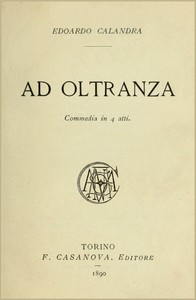
Ad oltranza : commedia in 4 atti by Edoardo Calandra
I stumbled upon Edoardo Calandra's Ad Oltranza while digging for lesser-known Italian classics, and I'm so glad I did. Published in 1882, this four-act comedy has a spark and bite that hasn't faded one bit.
The Story
The play revolves around two pillars of their community, Stefano and Paolo. These men have been friends since childhood, but they are now fanatical, opposing members of the local 'Right' and 'Left' political clubs. Their rivalry isn't just for show; it dictates everything, from where they shop to how they decorate their homes. Their families are collateral damage, forced to live in a state of perpetual, silly conflict. The plot kicks into gear when Stefano's daughter, Livia, and Paolo's son, Carlo, confess they are deeply in love and wish to marry. This throws both households into chaos. The fathers are horrified at the idea of mixing their 'pure' political bloodlines. What follows is a whirlwind of secret meetings, heated arguments, absurd plotting, and the desperate attempts of the younger generation—and the more sensible women in the family—to find a way through the stubbornness of their elders.
Why You Should Read It
What grabbed me wasn't just the plot, but how Calandra uses it. This isn't a dry political essay. It's a character-driven comedy about how people use beliefs as weapons in their personal lives. Stefano and Paolo aren't evil; they're just tragically, hilariously committed to being 'right' at all costs. You see how their feud strains their wives and isolates their children. The real heart of the play lies with Livia and Carlo, and the clever, often exasperated women around them, who have to navigate the minefield created by the men's pride. Calandra's dialogue is witty and fast-paced, making the 19th-century setting feel immediate. You'll recognize these types of people—the uncompromising ideologue, the peacemaker, the young lovers—which makes their struggle both funny and poignant.
Final Verdict
Ad Oltranza is a perfect pick for anyone who enjoys sharp social comedies like those by Oscar Wilde or Molière, but wants to explore an Italian voice. It's for readers who love historical fiction that doesn't read like history, and for anyone who's ever argued politics at a family dinner and lived to regret it. While the political labels are specific to its time, the human behavior—the vanity, the love, the sheer stubbornness—is timeless. If you're looking for a short, smart, and satisfying play that mixes laughter with a thoughtful look at human folly, Calandra's classic is waiting for you.
Legal analysis indicates this work is in the public domain. You do not need permission to reproduce this work.
Robert Hernandez
5 months agoAs someone working in this industry, I found the insights very accurate.
David Moore
7 months agoThe layout of the digital version made it easy to start immediately, the cross-referencing of different chapters makes it a great study tool. I am looking forward to the author's next publication.
Linda Smith
2 years agoI decided to give this a try based on a colleague's recommendation, the insights into future trends are particularly thought-provoking. A perfect balance of theory and practical advice.

David Davis
5 months agoMy first impression was quite positive because the logic behind each conclusion is easy to follow and verify. Top-tier content that deserves more recognition.